
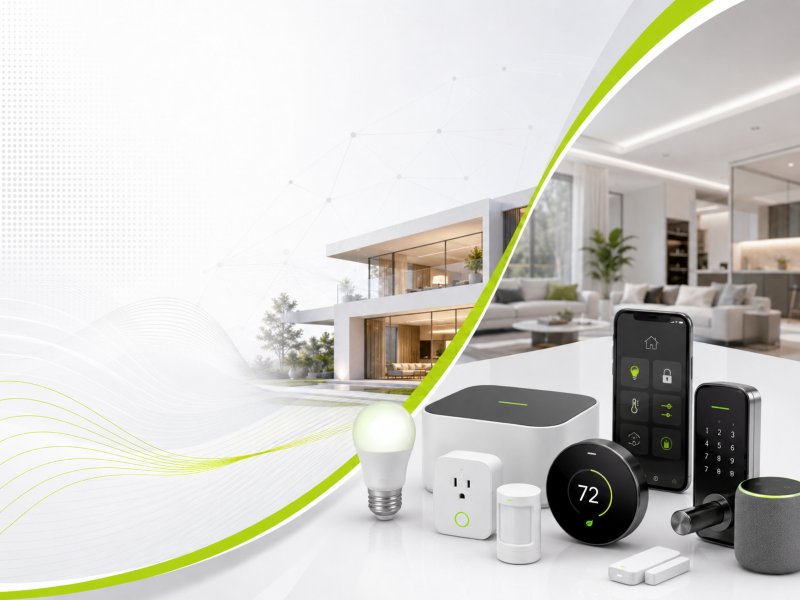
Smart Home Solutions
Smart home solutions represent a modern approach to managing houses, apartments, villas, residential buildings and smaller commercial spaces by connecting various electrical, electronic and security systems into one functional environment. The goal of a smart home is not only comfort, but also improved safety, better energy efficiency, simplified control and automation of everyday processes.
In recent years, the smart home market has developed rapidly. A large number of manufacturers, new devices, wireless technologies, applications, cloud platforms and automation systems have appeared. This development has created many new possibilities, but also certain risks. For this reason, a smart home system should not be selected only based on price or an attractive mobile application, but according to reliability, standardized protocols, manufacturer quality, long-term support and the ability to integrate equipment from other manufacturers.
Connecting electrical devices, lighting, heating, cooling, blinds, locks, sockets, sensors, cameras, alarms and other systems should never be taken lightly. A poorly designed or improperly installed system can lead to unstable operation, communication problems, loss of functionality, security risks and even material damage. Proper design, careful equipment selection, professional installation and correct configuration are therefore essential.
A high-quality smart home solution should enable integration of different systems such as lighting, heating, cooling, ventilation, blinds, curtains, gates, garage doors, locks, intercoms, CCTV, alarm systems, access control, water leak detection, energy metering, audio systems and multimedia. This allows the user to control the entire facility centrally, whether through wall switches, touch panels, mobile applications, voice commands or automated scenarios.
One of the most important characteristics of a modern smart home system is the ability to integrate equipment from different manufacturers. Closed systems that support only their own devices can become a limitation in the future, especially when the user wants to expand the system, replace equipment, integrate new technologies or migrate to a more advanced platform. For this reason, it is recommended to use standardized and widely accepted protocols such as KNX, Zigbee, Wi-Fi, Modbus, DALI and other communication standards that provide greater flexibility and long-term sustainability.
KNX is often used as a professional standard for building automation, especially when high stability, wired infrastructure and reliable operation of key functions are required. Zigbee is suitable for wireless connection of sensors, switches, lighting and smaller devices. Wi-Fi devices are very common and convenient, but require careful network and security planning. Modbus is often used for connecting energy, heating, cooling, ventilation and technical systems. DALI is especially important for professional lighting control, dimming, lighting scenes and control of lighting groups.
Smart home solutions are very similar to BMS systems, as both concepts are designed for centralized management of building technical systems. The main difference is that BMS is typically used in larger commercial, industrial, hotel and public facilities, where industrial-grade equipment, more complex infrastructure, advanced monitoring and stricter reliability requirements are applied. Smart home systems are adapted to residential and smaller commercial environments, using equipment that is often easier to use, aesthetically suitable for interiors and designed for everyday user needs. However, the boundary between these two concepts is becoming smaller, as modern smart home solutions increasingly include functions that were previously characteristic only of professional BMS platforms.
Scenes and automations are among the most valuable features of smart home systems. With a single button press, or automatically based on sensors and predefined conditions, different operating modes can be activated. For example, a “Coming Home” scene can turn on the lights, adjust the temperature, disarm the alarm, open the garage door and start background music. A “Leaving Home” scene can turn off unnecessary consumers, lower the blinds, lock the doors, activate the alarm and switch the property into energy-saving mode. Other possible scenes include night mode, movie mode, work-from-home mode, relaxation, garden irrigation, sun protection or presence simulation when users are away.
AI technology is becoming increasingly important in smart home solutions. Artificial intelligence can analyze user habits, energy consumption, temperature, lighting, room occupancy and other data in order to automatically suggest or activate optimal operating modes. AI can be used for smarter heating and cooling control, detection of unusual events, video analytics, voice assistants, predictive automation and better adaptation of the space to the real needs of its users.
Cybersecurity must be one of the key elements in the design and implementation of any smart home system. Since a smart home can be connected to the internet, mobile applications, cameras, alarms, locks, gates and other critical systems, it must be protected from misuse, unauthorized access and cyber attacks. A poorly secured smart home system can compromise user privacy, enable access to video footage, unlock doors, control devices, monitor residents’ habits or cause material and non-material damage.
A special risk is that an unsecured smart home system can be used as a “back door” to access other security systems within the facility, such as CCTV, intrusion alarm, access control or the business network. For this reason, it is important to properly segment the network, use strong passwords, regularly update devices, choose trusted manufacturers, restrict remote access and apply professional security measures.
A professionally designed smart home system provides users with a high level of comfort, safety, energy efficiency and control. When based on quality equipment, standardized protocols and integration with other systems, a smart home becomes a reliable long-term solution that improves everyday life, saves energy and makes the facility more functional, secure and modern.