
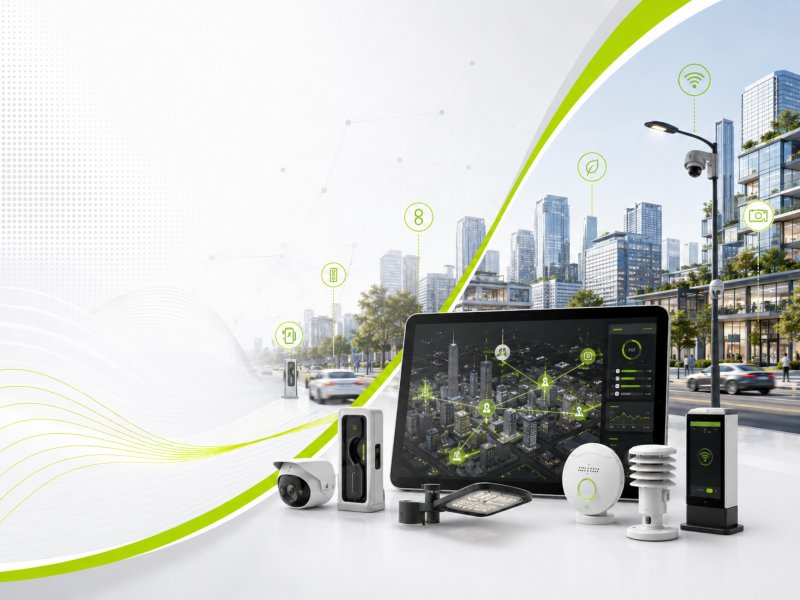
Smart City
Smart City solutions represent a combination of modern technologies, sensor systems, communication networks, software platforms and integrations that enable more efficient management of urban infrastructure, public spaces, traffic, utility services, safety systems and the overall quality of life for citizens. The goal of a smart city is not simply to introduce new technologies, but to apply them in a practical way that improves city operations, optimizes resource consumption and enables faster response from responsible services.
Smart City systems are generally managed by city administrations, public utility companies, transport authorities, emergency services, public safety organizations and other institutions responsible for urban infrastructure. Due to the complexity of these systems, the large number of stakeholders and various legal, technical and organizational requirements, it would be unrealistic to claim that one company can provide everything a modern city needs. However, through experience in technical security, telecommunications, sensing technologies, video surveillance, automation and software integrations, we can provide and integrate many technologies that represent an important part of modern Smart City systems.
One of the key segments of a smart city is data acquisition from different sources. These may include hydrometeorological stations, air quality sensors, temperature sensors, humidity sensors, pressure sensors, wind and rainfall sensors, water level sensors, flow sensors, parking occupancy sensors, vehicle and pedestrian counting systems and other devices that enable real-time monitoring. Properly collected and processed data provides better insight into the condition of the city, supports better planning and enables timely decision-making.
Monitoring hydrometeorological stations enables tracking of weather conditions, microclimate changes, rainfall, wind, temperature, humidity and other parameters important for utility services, traffic management, agriculture, tourism, public safety and emergency response. This data can be displayed in central software platforms, used for public information or integrated with other systems such as warning systems, public displays, interactive totems and city information portals.
Smart City technologies have a particularly important role in parking systems. Monitoring of parking garages, open parking areas and street parking zones can include occupancy control, vehicle counting, acquisition of available parking spaces, integration with gates, barriers, payment systems, LPR/ANPR cameras and user applications. Available parking spaces can be detected using modern sensor technologies with LoRa, LTE, Wi-Fi or other communication methods, enabling real-time display of parking availability.
In addition to traditional sensors, data acquisition can also be performed through video analytics using AI technology. Cameras combined with advanced algorithms can detect parking space occupancy, vehicle movement direction, traffic congestion, prolonged presence, improper parking, movement through specific zones, people counting, vehicle counting and other events relevant for urban management. AI video analytics allows existing video surveillance infrastructure to gain additional value and become an active source of operational data, rather than only a system for reviewing recordings.
Monitoring river levels, canals and other watercourses is an important part of flood protection and emergency management. Water level sensors, hydrometeorological stations, cameras, IoT communication and central software monitoring can provide timely warnings to responsible services and citizens. Such systems can be connected to public notification platforms, public address systems, sirens, interactive totems, mobile applications and other communication channels.
Drones are increasingly used in modern city systems. They can be used for monitoring large areas, infrastructure inspection, traffic overview, event supervision, watercourse monitoring, inspection of hard-to-reach locations, support for utility services and rapid assessment of conditions in emergency situations. In addition to drone usage itself, it is important to provide supervision of their operation, flight records, definition of operating zones, privacy protection and compliance with applicable regulations.
Public notification is one of the key elements of the Smart City concept. Information can be distributed through interactive totems, public displays, LED panels, mobile applications, web portals, public address systems and emergency warning systems. In this way, citizens can be informed about traffic conditions, available parking spaces, weather conditions, hazards, roadworks, changes in movement regimes, public events or emergency situations.
Public address and emergency warning systems have a particularly important role in emergency events, natural disasters, fires, floods, evacuations and other situations that require fast communication with a large number of people. Combined with sensors, video analytics, hydrometeorological data and central monitoring, these systems can significantly contribute to faster response and improved public safety.
Smart City solutions may also include integration with video surveillance, access control, parking systems, payment platforms, telemetry, energy metering, public lighting, BMS platforms, communication networks and software portals. The key value is not only in a single device or sensor, but in connecting all these elements into a unified information system that enables monitoring, analysis, reporting and automated responses.
Reliable communication networks are essential for stable operation of Smart City systems. Depending on the purpose and location, optical networks, Ethernet infrastructure, LTE/5G, Wi-Fi, LoRa, radio links and other communication technologies can be used. The choice of technology depends on the amount of data, required speed, power availability, distance, security requirements and expected autonomous operating time of sensors.
Special attention must be given to data security, privacy protection and system access control. Smart City infrastructure often collects and processes large amounts of data from public spaces, which makes it important to properly design the network, protect communications, define access rights, maintain activity logs and ensure compliance with applicable regulations. Technology must serve both the city and its citizens, with responsible use and clearly defined procedures.
Professionally designed Smart City solutions enable cities and public utility companies to gain better insight into the state of infrastructure, manage resources more efficiently, improve traffic and parking organization, inform citizens faster and respond more effectively in emergency situations. Through the integration of sensors, video analytics, AI technology, communication networks and software platforms, a modern city gains the tools required for smarter, safer and more efficient operation.