
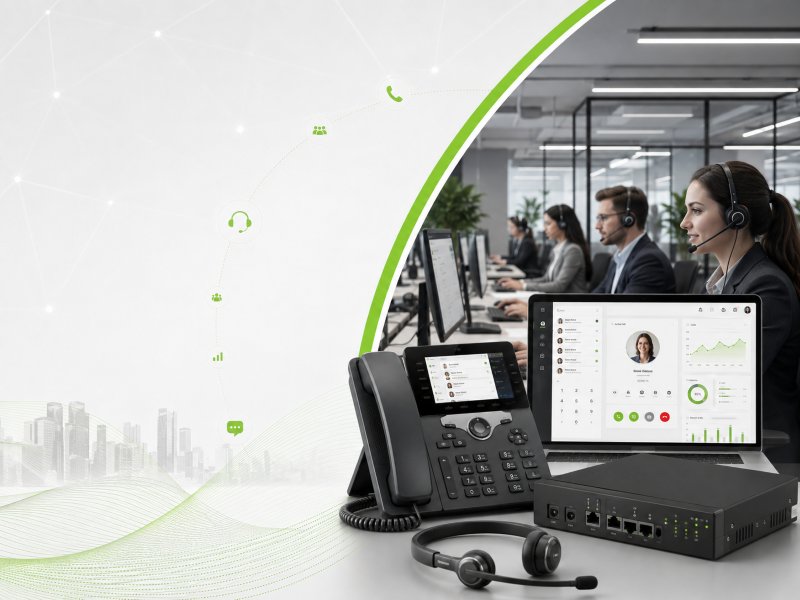
VoIP Systems
VoIP systems are modern solutions for transmitting voice over IP networks, using computer networks and the internet instead of traditional telephone infrastructure. Voice over IP technology has made telephony more flexible, accessible, functional and much easier to integrate with other business systems. Although mobile phones have largely reduced the everyday use of fixed-line telephones, especially in households, VoIP telephony remains extremely important and often irreplaceable in business environments, industry, public services and call centers.
With the development of the internet, the expansion of broadband connections and the growth of computer networks, fixed telephony is no longer strictly tied to a single physical location. VoIP has enabled an extension, office phone, operator or call center to work over an IP network from the office, a remote location, another city or even from a home environment. In this way, the “fixed” phone is no longer truly fixed, but becomes part of a flexible communication platform.
In households, VoIP systems are used much less than before, mainly because of the wide use of mobile phones and internet communication applications. In the business world, however, the situation is completely different. Companies, industrial systems, hotels, healthcare institutions, customer support centers, distribution centers, logistics companies, sales teams and technical support departments still need stable, controlled and professional telephone communication. This is where VoIP systems show their true value.
One of the greatest advantages of VoIP technology is the significant reduction in the cost of implementing and maintaining telephone systems. In the past, call centers required expensive dedicated telephone infrastructure, a large number of physical lines and complex equipment. With the development of IP telephony, SIP trunks, software-based PBX systems and virtual PBX solutions, call center implementation has become much more affordable, flexible and scalable. Today, a call center can be organized using IP phones, softphone applications, headset devices and central software for advanced call management.
VoIP systems provide many features that were difficult, expensive or technically complex in traditional telephony. These include voice menus, IVR systems, call queues, call forwarding, call recording, billing, detailed call logs, operator performance statistics, call distribution by groups, call center working hours, voicemail, conference calls, CRM integration and automated notifications.
The ability to log, bill and record calls is especially important for business users. The system can display the number of received, missed and outgoing calls, call duration, waiting time, operator workload, answer rate and other parameters important for performance analysis. Based on this data, managers can better organize employees, monitor communication quality, analyze client behavior, improve customer support and identify market needs.
Call recording is highly valuable in call centers, sales teams, customer support, technical support, service departments and sectors where proof of communication or later analysis is important. Recordings can be used for quality control, employee training, complaint resolution, verification of agreements with clients and improvement of internal procedures. At the same time, it is very important to follow legal requirements, inform users properly and comply with data protection rules.
VoIP systems also play an important role in audio and video conferencing. With the development of business communication platforms, users can participate in meetings through IP phones, computers, mobile devices, conference terminals or integrated software solutions. These systems make team collaboration easier, reduce the need for travel, speed up decision-making and enable more efficient communication between remote locations.
VoIP systems proved to be especially important during the pandemic, when many people were forced to work from home or from remote locations. Thanks to IP telephony, companies were able to continue operating customer support, technical support, administration and sales teams without requiring physical presence in the office. Operators could receive and make calls through softphone applications, VPN connections, cloud PBX platforms or IP phones connected to their home networks.
During that period, VoIP systems also played a significant role in call centers used by crisis headquarters, hospitals, healthcare institutions, public services and support centers. A large number of calls, the need for quick call routing, recording, workload distribution and remote operator work demonstrated how important flexible and properly designed IP telephony is in crisis situations.
VoIP systems can be local, cloud-based or hybrid. A local IP PBX is commonly used when the user wants full control over the system, integration with existing infrastructure or operation within a private network. Cloud VoIP solutions allow faster implementation, reduced need for local equipment and easier connection of remote users. Hybrid solutions combine the advantages of both approaches and are often a good choice for companies with multiple locations, existing infrastructure and a need for additional flexibility.
In business facilities, VoIP telephony can be integrated with access control, intercom systems, video surveillance, alarm systems, hotel PMS platforms, CRM solutions, helpdesk systems, time attendance platforms and business applications. For example, an intercom call can be forwarded to an IP phone or mobile application, an alarm event can trigger an automatic call to responsible personnel, and a CRM system can display client information as soon as a call reaches the operator.
A reliable VoIP system depends heavily on a well-designed computer network. Voice traffic requires a stable connection, properly configured QoS, good network segmentation, quality switches, PoE power for IP phones, an appropriate internet connection and correctly configured firewall and NAT settings. A poorly designed network can cause interruptions, delay, echo, poor audio quality or dropped calls, which is why a VoIP system must be planned together with the network infrastructure.
VoIP system security is also very important. Unsecured IP telephony can be exposed to misuse, communication interception, unauthorized international calls, attacks on the PBX or attempts to access the business network. For this reason, strong passwords, encryption where available, VPN access for remote users, proper firewall rules, call restrictions, regular updates and system monitoring should be applied.
A professionally designed VoIP system provides companies with stable communication, lower costs, flexible multi-location operation, easier call center organization, detailed analytics and better integration with other business systems. Despite the development of mobile phones and internet communication applications, business IP telephony remains one of the most important tools for efficient, controlled and measurable communication in modern business.